Writing
C++ is not dying in quant finance - it's getting more critical
While the industry obsesses over Python and LLMs, the engineers who actually move markets are doubling down on C++.
Every few years, someone publishes a piece declaring C++ dead in finance. Python won, they say. AI will handle the rest. You can build a strategy in a Jupyter notebook and call it a day.
That's a comfortable narrative. It's also wrong - and the people saying it usually aren't the ones responsible for microsecond-level execution.
Latency doesn't care about your productivity argument.
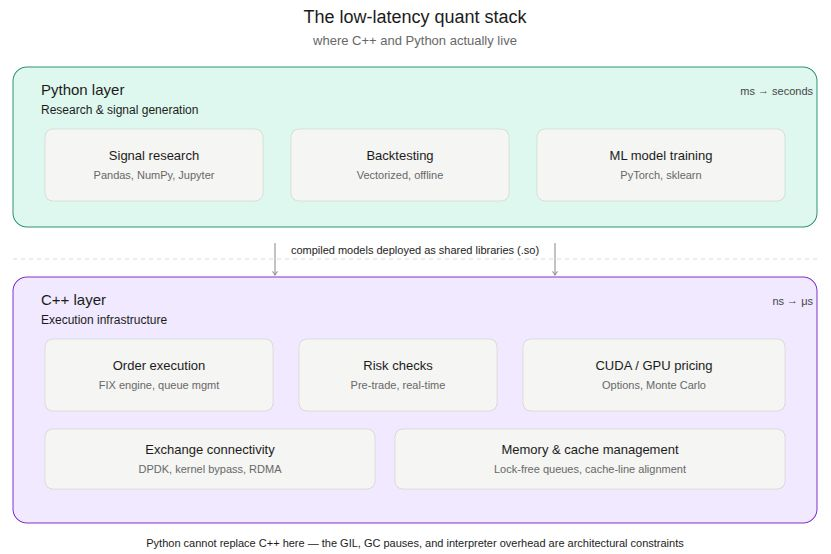
Where Python actually ends
Python is genuinely excellent for research, signal prototyping, and data wrangling. No one serious disputes that. But the moment a strategy needs to live in production - co-located, competing for queue priority at the exchange level - Python's runtime overhead becomes a liability, not a minor inconvenience.
The GIL, garbage collection pauses, and interpreter overhead are architectural constraints, not version problems. You can't pip install your way out of them.
What's actually driving C++ demand right now
Three things are making C++ more relevant in 2026, not less:
CUDA and GPU-accelerated quant. The AI boom didn't kill C++ - it expanded the surface area where C++ expertise matters. Writing performant CUDA kernels for real-time risk calculations or options pricing requires C++ fluency. Python bindings are a convenience layer on top of C++ infrastructure, not a replacement for it.
The rise of systematic market-making. As more alpha migrates to market-making and short-horizon strategies, the competitive edge compresses to infrastructure. Firms that can squeeze latency at the memory allocation and cache-line level win. That's a C++ problem.
Networking and kernel bypass. DPDK, RDMA, kernel-bypass networking - the low-latency stack is entirely a C/C++ domain. No Python wrapper abstracts that away without destroying the point of it.
AI isn't replacing C++ quant engineers. It's making the ones who can't write performance systems code easier to identify.
What this means for hiring
For hiring managers: the candidate who knows Python well but has never reasoned about memory layout, false sharing, or branch prediction is a research hire, not a systems hire. Conflating the two is an expensive mistake.
For quant developers: if your C++ knowledge stops at STL containers and basic templates, that's a skills gap worth closing. The firms building the next generation of execution infrastructure aren't looking for Python-first engineers who dabble in C++.
The narrative that C++ is legacy tech in finance is mostly spread by people who don't work in latency-sensitive systems. In the parts of the market where microseconds determine profitability, C++ isn't going anywhere - and neither is the premium on engineers who can write it well.